
Winter Garden City Directory Holdings
The most reliable starting point is the UCF STARS Orange County Library System collection, backed by page-level citations in the National Register nomination and local archive holdings. Coverage must be checked edition by edition.
| Collection | Years | Where held | Access |
|---|---|---|---|
| Orange County and Orlando City Directory | 1913 | OCLS and UCF STARS | Digitized; expressly includes Winter Garden |
| Ernest Miller Orange County Directory | 1915 and 1921 | NPS-cited editions | Winter Garden pages 260-263 and 307 cited |
| R.L. Polk Orange County Directory | 1928, 1936, 1941 | NPS-cited editions | Specific Winter Garden pages cited |
| Southern Bell telephone books | 1923-1931 | UCF/OCLS digital run | Edition-by-edition online access |
| Apopka/Winter Garden telephone book | 1965 | Regional History Center guide | Appointment for physical material |
| Winter Garden voter registers | 1914-1928 | UCF STARS index | Named District 11 and 35 rolls |
| WGHF archive | Local historical span | 21 E Plant Street | Research contact; Tuesday-Saturday 11-3 |
This Winter Garden city directory coverage table distinguishes a confirmed local edition from a broad county title. It also keeps a printed directory separate from a voter roll or telephone book, even when all can provide names.
The digitized collection landing page appears in the assigned image.
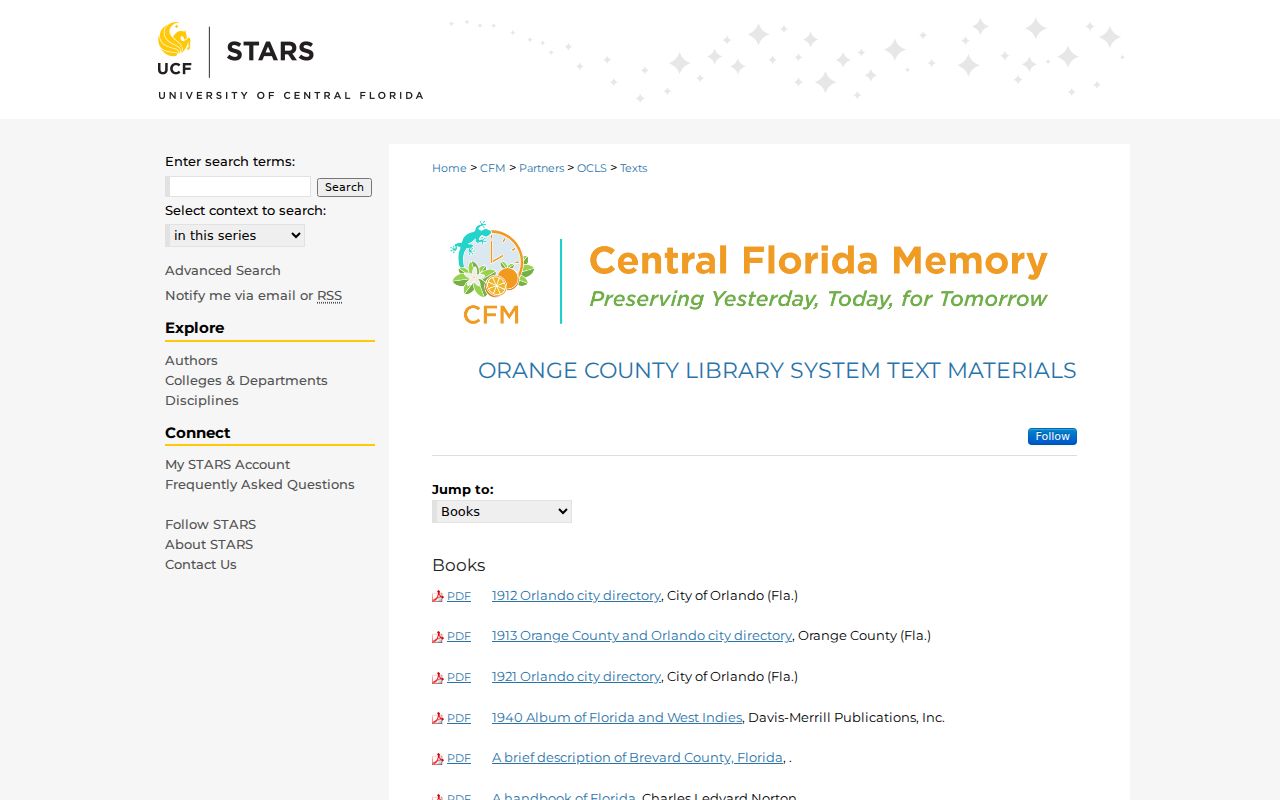
The item records help confirm the edition before names and addresses are transcribed.
Confirm the 1913 Winter Garden Directory
The 238-page Directory Publishing Company volume is the strongest digitized anchor because its catalog expressly includes Winter Garden and Ocoee. UCF reproduced it in 2005 from high-resolution TIFF images. A researcher can cite the item, page, printed locality, and exact spelling instead of relying on an uncited name snippet.
The 1913 item record is shown in the second assigned image.
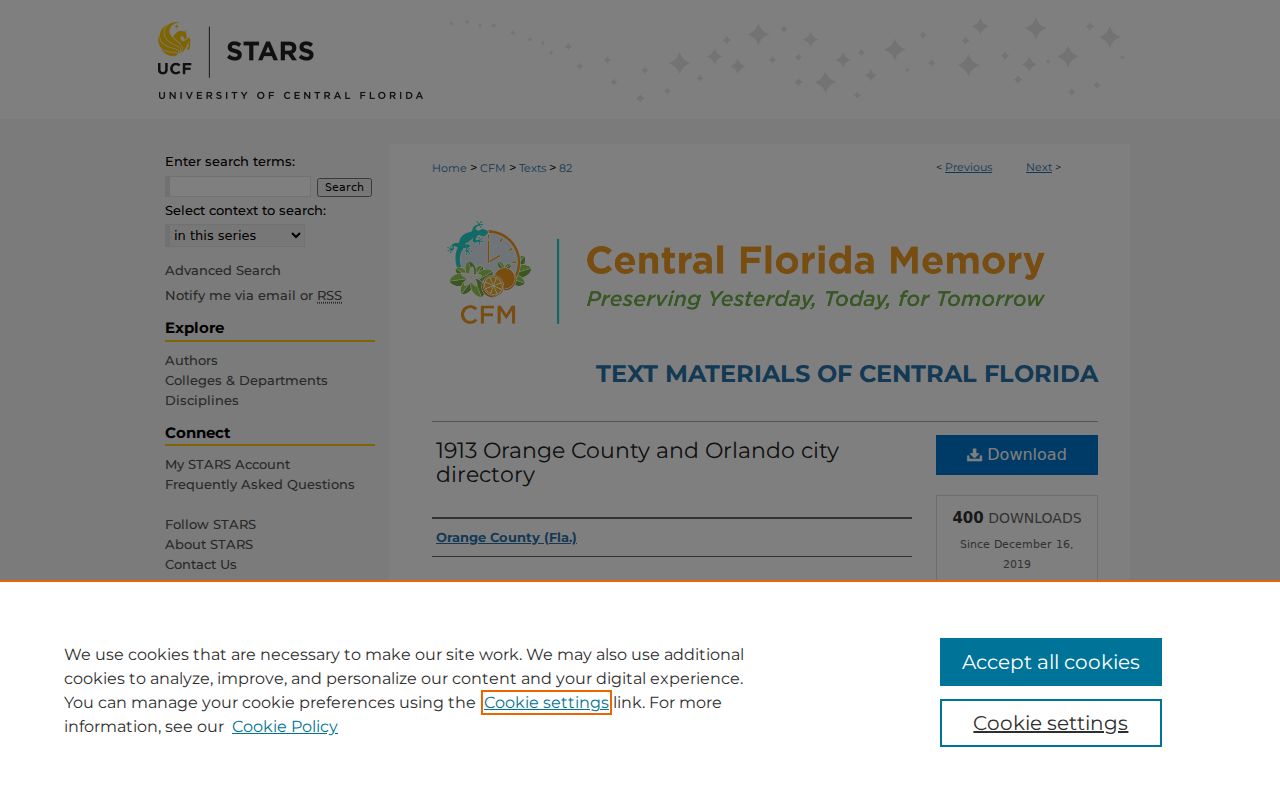
Save the title page and locality page with the entry. That preserves context if the same surname appears elsewhere in Orange County.
Winter Garden Directory Page Trails
The downtown historic-district nomination supplies a practical shortcut. It cites Winter Garden on pages 260 through 263 of the 1915 Ernest Miller directory and page 307 of the 1921 edition. R.L. Polk references point to page 684 in 1928, several pages in 1936, and pages 681 and 688 in 1941. These citations establish local evidence without claiming that every page or resident was captured.
Search surname variants and initials. Citrus, railroad, grove, and packinghouse ties may explain why a person appears under a firm, rural route, or nearby locality rather than a modern numbered street. Record those words exactly before normalizing them.
Read Winter Garden City Directory Entries
The research did not expose an entry image or abbreviation key for direct inspection. Therefore only the printed alphabetical name heading and locality/page setting are confirmed across the cited material. Spouse, occupation, home address, ownership, renter, and widow marks are edition-dependent and must be verified from the key in the volume.
| Printed name | Transcribe spelling, initials, and ordering exactly. |
|---|---|
| Locality and page | Confirms where the entry sits in that edition. |
| Address | Record only when visible; do not convert it to a modern address without evidence. |
| Work or household marks | Use only after checking that edition’s key. |
| Source citation | Keep title, publisher, year, page, and repository. |
- Criss-cross directory
- A directory arranged by street and address; no complete Winter Garden shelf run was confirmed online.
- Householder index
- An address-oriented list whose fields depend on the edition.
- Abbreviation key
- The publisher’s legend that defines shortened words and symbols.
Winter Garden Telephone Directory Years
UCF and OCLS identify a detailed Southern Bell run from 1923 through July 1931, with seasonal editions in several years. The Regional History Center guide adds an Apopka/Winter Garden telephone book from 1965. Telephone listings are useful checkpoints, but an unlisted line, shared service, changed exchange, or missing locality can hide a household.
A 1921 Orlando catalog record names Ocoee but does not list Winter Garden. That quirk is a warning: title and county alone cannot prove city coverage. Inspect the contents and locality headings before counting a no-result as evidence that a person left.
Bridge Winter Garden Directory Gaps
UCF’s named voter-register series provides an unusually direct bridge between censuses. District 11 registers cover 1914 through 1922, 1926, and 1928; District 35 material spans 1914 through 1928. A voter entry is evidence of registration in its district and year, not a full household.
Compare the voter name with the directory’s initials, locality, and address. Then use the public 1920, 1930, 1940, or 1950 federal census schedule where appropriate. The 1950 census is the latest named federal population schedule now public under the 72-year release rule.
Note: A voter register can place a named adult between census years, but it should not be treated as a household directory.
Search Winter Garden Family Archives
The Winter Garden Heritage Foundation is the first local fallback. Its archive holds family files, school photographs, newspapers, maps, directories, books, agricultural and railroad material, artifacts, and oral histories. New East Winter Garden family photographs, documents, scans, and recorded memories were gathered in 2024, so relevant evidence may exist even when an older catalog does not describe it.
The Brechner Research Center at the Orange County Regional History Center offers free appointment research and access to a collection of more than 35,000 artifacts, photographs, and archival items. It is useful when a family moved through Ocoee, Oakland, Orlando, or other Central Florida communities.
The assigned State Archives image links to the State Archives of Florida.
State and regional archives are fallbacks, not substitutes for checking the confirmed local edition first.
East Winter Garden Directory Gaps
Historic East Winter Garden developed around Center Street, citrus work, and packinghouse labor. The Loveless Addition was platted in 1910, Big Quarters grew in the early 1940s, and churches and the Winter Garden Colored School became key community anchors. Mainstream directories may undercount Black residents or list people through a firm, church, rural route, or nearby locality.
School material, church history, voter registers, oral histories, and community-held photographs are therefore core evidence, not decoration. Search terms should include Historic East Winter Garden, East Winter Garden, Center Street, Loveless Addition, and Big Quarters, with the term tied to the era in which it was used.
Pair Winter Garden Directories With Maps
Sanborn fire maps from 1917, 1924, and 1950 show building footprint, shape, construction, use, doors, windows, roofs, and fire infrastructure. They do not identify occupants. WGHF also held a paste-up map updated from 1924 through 1960, which should not be confused with a separately published annual edition.
Use the map to confirm that a building existed, then use a city directory, census, voter register, deed, or permit to connect a person to it. The modern Winter Garden street directory takes over when the question shifts to current parcels and address-keyed files.
Trace Winter Garden Families by Year
A city directory works best as one dated point in a chain. Absence can mean a move, death, missed canvass, an unlisted phone, or an edition that did not cover outlying Winter Garden. It is not proof that the person left Orange County.
- Select an edition whose catalog or cited pages confirm Winter Garden coverage.
- Search the surname, initials, and spelling variants, then save the exact page citation.
- Compare the next confirmed edition and note only verified changes in name or address.
- Bridge gaps with the voter registers and public census schedules.
- Use deeds, legal descriptions, maps, archive files, probate, and newspapers to test the timeline.
The 1886 courthouse fire adds a preservation break. Later official minutes said it burned with all county records, while some older commission minutes survive or were reconstructed. Treat provenance carefully and seek later recitals, directories, tax material, and archival sources when an early official book is missing.
Build a citation for every directory appearance before joining the entries into a life story. Record the printed title, publisher, edition date, locality heading, page, exact name form, address and any abbreviation whose key has been checked. If the same initials appear at a new address, compare an occupation, spouse, business, voter district or deed party before calling it the same resident. Then search one edition on either side of the target year. A repeated address can be stronger than a name alone, while a repeated surname at different addresses may represent relatives or namesakes. When the printed street cannot be matched to a current map, carry the subdivision, business, church, school or rural-route clue into WGHF files and Sanborn maps. This method preserves uncertainty and shows exactly which source supports each step.