
Winter Garden Address Evidence
A sound search for Winter Garden previous residents starts by matching the source to the time period. The assessment roll identifies the parcel and gives the deed pointer that starts the title trail. Printed directories and voter registers provide named checkpoints in select years. Census schedules can reconstruct a household, while fire-insurance maps show the building rather than the people in it.
The dates below are the confirmed local coverage. Directory coverage must be checked edition by edition. A catalog title alone does not prove that a volume includes Winter Garden.
| Source | Years Covered | Where Held | What It Shows |
|---|---|---|---|
| Official records and deeds | County describes records into the 1840s; certification display begins in 1878 | Orange County Comptroller | Title parties, legal description, recording order, return addresses |
| Confirmed local directories | 1913, 1915, 1921, 1928, 1936, 1941; telephone book in 1965 | UCF, cited editions, History Center | Named entries and address context, varying by edition |
| Winter Garden voter registers | Districts 11 and 35, 1914 through the 1920s | UCF STARS | Registered names between census years |
| Federal census | Named schedules through 1950 | NARA and HeritageQuest | Household, age, kinship, birthplace, occupation |
| Sanborn maps | 1917, 1924, 1950; local paste-up updated 1924 to 1960 | LOC, UF, WGHF | Building footprint, use, materials, physical change |
| Permits and court files | Permit cutoff not published; court docket mostly about 1990 forward | City Building and Orange Clerk | Work history, inspections, probate, public case events |
When the web trail ends, call or visit the custodian. The Comptroller Official Records office is at 109 E Church Street, Suite 300, Orlando, and 407-836-5115. Archive and library routes matter just as much for older households.
Start With Winter Garden Parcels
Open the Orange County Property Appraiser Property Search with the street address. Record the parcel ID, current owner, situs address, legal description, subdivision, sale history, and deed book, page, or instrument number. Situs means the physical parcel location. The separate mailing address is where the tax notice goes. It does not prove that the owner lived at the house.
The parcel ID and legal description are more durable than the display address. They keep the search on the same lot if a street label, city designation, or postal convention changes. Actual and effective year-built fields, building features, and prior qualified sales also help place changes on the Winter Garden timeline.
- Legal description
- The lot, block, subdivision, or metes-and-bounds wording that identifies land in title records.
- Chain of title
- The sequence of deeds that transferred the same property from owner to owner.
- Grantor
- The party giving or selling an interest in a recorded instrument.
- Grantee
- The party receiving or buying that interest.
Note: A homestead exemption can support owner-occupancy, but it does not identify every person who lived at the address.
Reverse Winter Garden Deed Records
The Orange County Comptroller Official Records search is a catalog of recorded instruments. It is not a true street-address directory. Move from the parcel card into the deed image, then use names and legal descriptions to work backward.
- Use the current owner and latest instrument number to open the acquisition deed.
- Confirm the same lot, block, subdivision, or other legal description.
- Take the seller, or grantor, and search that person as a grantee before the sale date.
- Narrow results by document type, recording range, book and page, or legal text.
- Repeat with each earlier deed, saving the image and full citation.
Search spelling variants and use Last First order where expected. Results may list document number, type, recording date, grantor, grantee, and legal text. Open the image for vesting terms, execution date, witnesses, notary, and full land description. Plain PDFs and printing are free. Certified copies cost $1 per page plus $2 certification per complete document.
Winter Garden Maps Meet Names
Sanborn fire-insurance maps and resident records complement each other. The 1917, 1924, and 1950 Winter Garden sheets can show a building’s shape, size, construction, use, openings, roof, and nearby fire or water features. They do not identify who lived inside. Directories, voter registers, and census schedules supply people, subject to each collection’s gaps.
Match one address across both kinds of evidence. First tie its block and lot to a Sanborn sheet. Check a confirmed directory year and the nearest released census. Compare the footprint again in the next map year. A changed outline may explain a permit or deed event, while a stable building and changing names may indicate household turnover.
| Map evidence | Structure, use, construction, and physical change |
|---|---|
| Directory evidence | A named entry when the edition covers Winter Garden |
| Census evidence | Named household ties in released schedules |
| Deed evidence | Legal ownership, not a complete resident list |
This is the key house-history comparison. A map proves the building. A named roll may place a person. Neither should be made to prove what it cannot show.
Pair Winter Garden Resident Years
The strongest printed checkpoint is the 1913 Orange County and Orlando directory because its catalog expressly includes Winter Garden. Later local evidence comes from cited Miller and Polk editions in 1915, 1921, 1928, 1936, and 1941, plus an Apopka and Winter Garden telephone book from 1965. For collection detail, use the Winter Garden city directory page.
- Select an edition whose Winter Garden coverage is confirmed.
- Search surnames, initials, and variants, then save the printed locality and address.
- Compare the next confirmed edition without treating omission as proof of a move.
- Bridge the gap with the 1920, 1930, 1940, or 1950 census.
- Return to the parcel legal description and deeds to test continuity.
The latest named federal population schedule open to the public is 1950 under the 72-year rule. A missing directory entry can reflect an outlying address, missed canvass, changed name, or an edition that excluded part of Winter Garden.
Winter Garden Voter Register Bridge
UCF identifies Winter Garden voter registers for District 11 in 1914 through 1922, with 1926 and 1928 material, and District 35 from 1914 through 1928. These named rolls can bridge a person between directory and census years. They record voter presence, not a full household.
Check the register after a confirmed directory hit, then compare the name, district, and date with the same address trail. Women, children, noncitizens, and unregistered people will be absent. That is a source limit, not proof they did not live there.
Note: Modern voter data has different access and privacy rules, so never project a historical register’s format onto today’s roll.
The 1886 Winter Garden Gap
An official Orange County account says the courthouse burned in 1886 with all county records. Yet digitized commission minutes from 1872 to 1880 exist. Some material survived, was copied, or was reconstructed. Provenance is vital for early previous residents.
Do not treat the fire as a clean cutoff. Ask the Comptroller about a specific book and date range. Check later deeds for recitals of earlier transfers, tax and census sources, preserved plats, directories, and archive files. County descriptions mention records into the 1840s, while the certification display begins in 1878. Those claims concern different parts of access and do not prove complete coverage.
Record survival. A missing online result can reflect the courthouse fire, an image gap, spelling, or a paper-only book. Confirm the series with its custodian.
Winter Garden House Files
The city’s Building Department page routes searches to BS&A by project address or permit number. Open details and inspections. Winter Garden launched the system in 2025, so ask City Hall for legacy files when an old project is absent. Building staff can be reached at 407-877-5136.
A municipal-lien report can add open or expired permits, code violations, fines, assessments, and city utility balances. It costs $30 per address, allows one property per form, and states a five-to-seven-business-day turnaround. It requires both the property PIN or folio and address.
The Winter Garden Heritage Foundation archive holds family files, photos, maps, newspapers, directories, books, and oral histories at 21 E Plant Street. It is open Tuesday through Saturday, 11 a.m. to 3 p.m., with 407-656-3244 for research questions.
The archive’s ongoing work appears in local preservation coverage.
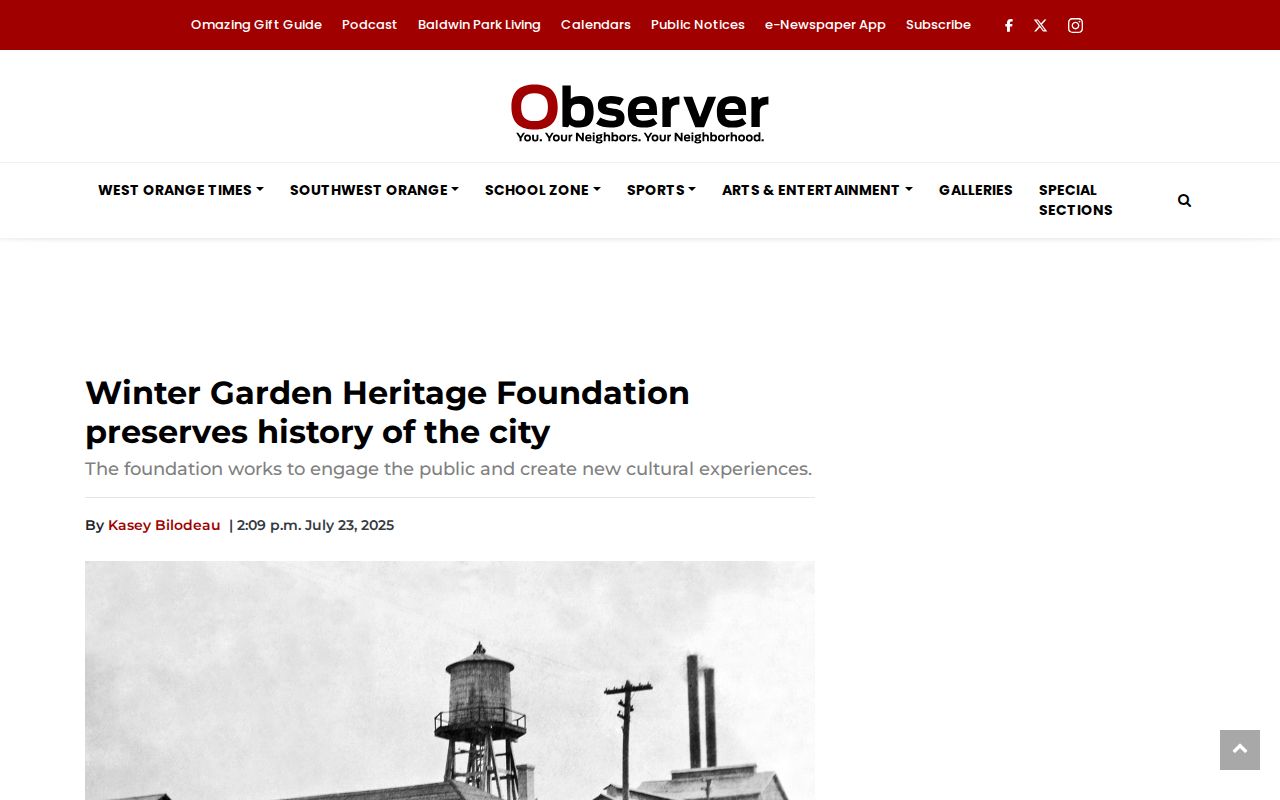
The captured source shows why an archive inquiry may uncover school, farm, rail, architectural, and family material that no deed index describes.
East Winter Garden Resident Memory
Historic East Winter Garden grew around Center Street. The Loveless Addition was platted in 1910, and Big Quarters grew in the early 1940s for farm and packinghouse workers. Churches and the Winter Garden Colored School were community anchors. Mainstream directories can undercount people linked to these places.
In 2024, WGHF invited families to share photos, papers, business records, and oral histories, with staff offering to scan items and record stories. The community-memory project documents that effort.
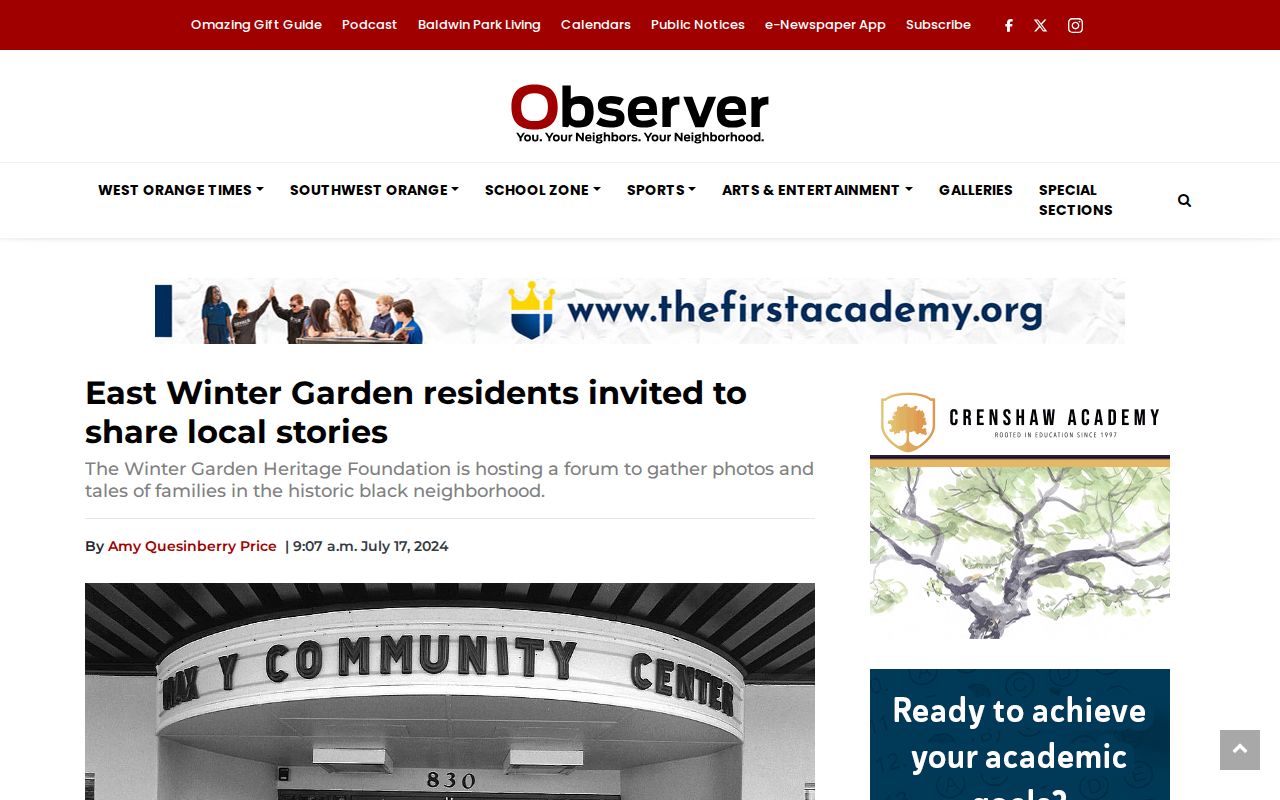
The collection may connect past residents to a school, church, grove, rail line, or business when a printed street entry is missing.
Finish Winter Garden Resident Trails
A backward address trail may end at death, an estate transfer, or a move. Search public probate material through the Orange County Clerk when a deed names an estate, personal representative, heir, or devisee. Petitions and notices may identify family roles and public addresses, though confidential filings remain unavailable.
Obituaries, cemetery sources, and newspapers can connect a decedent to relatives and an era, but no authoritative public name-searchable Winter Garden cemetery index was found. Use WGHF, the Orange County Regional History Center, Winter Garden Branch, and West Oaks genealogy center as fallbacks. Ask for a named collection and date span.
Lawful house history. Use past-resident records for genealogy, estates, and property research. Never use an address trail to watch, threaten, or harass anyone.
State what each record proves. A deed proves title transfer. A directory places a printed name in one edition. A census records a household on its date. Together they can support a careful history without turning clues into claims.